

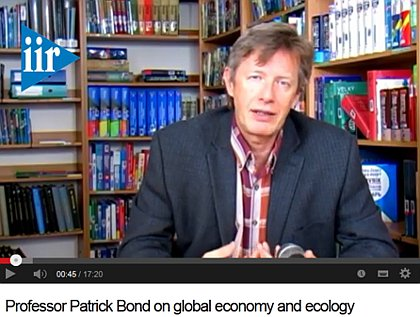
We interviewed a respected figure in the fields of political economy, environment, social policy, and geopolitics. Professor Bond currently teaches at the University of KwaZulu-Natal and is an advisory board member in several high-profile journals.
He answered these questions:
(00:10) – What makes the marxist critique of the global economy still valuable and relevant today?
(02:18) – In your view, capitalism is the main driver in the destruction of nature. Historically though, the socialist bloc was more damaging. How do you explain that?
(04:31) – Why are you so critical of the BRICS group’s recent rise to world prominence?
(08:05) – BRICS group also contributes to environmental problems. Do you think there is really nothing that market forces can do to alleviate the situation?
(10:25) – Would you agree that Africa is rising in a similar fashion the BRICS group did?
(13:10) – What you paint here seems to be a glomy picture of the world. Do you see any signs of optimism in your research and activism?


At Warsaw’s COP19 climate summit, South Africa has no bragging rights
Patrick Bond 12 November 2013
Can Pretoria’s delegation to the Conference of the Parties COP19 in Warsaw – the annual UN Framework Convention on Climate Change summit which opened on Monday and closes on November 22 – make a convincing statement that one of the world’s highest per-capita greenhouse-gas polluters is reforming?
In the wake of the typhoon which did such incalculable damage to the Philippines, meaningful demands must be made upon richer countries to urgently cut emissions. This will require the Brazil-Russia-India-China-South Africa bloc to show they can reverse course, while meeting the vast social and energy needs of their increasingly angry low-income constituencies.
Intense social protests underway in all the BRICS countries reflect, in part, corporate-state connivance: extracting resources and polluting cities at a record rate, while providing inadequate or unaffordable services – from public transport in Brazil to electricity here in SA – to the masses.
If instead of rejoining the big emerging powers and Washington, as happened so disastrously at the 2009 Copenhagen COP15, couldn’t the SA delegation to Warsaw unite more closely with the hardest-hit African countries to express justified climate grievances?
Regardless, Pretoria would be taken more seriously if seen to be honouring its official pledge: cutting emissions to a “trajectory that peaks at 34 percent below a ‘Business as Usual’ trajectory in 2020.”
But that highly unlikely promise, made just before Copenhagen, was contingent on the North paying Pretoria (unspecified) climate funds and transferring low-carbon technology without the usual debilitating royalty requirements, according to Environment Minister Edna Molewa.
So far the strategy has not paid off in any way.
Will Molewa stand tall in coal-stained Poland the next two weeks, negotiating as hard as needed to save the estimated 182 million Africans expected to die prematurely during this century, thanks to climate change?
- How can she, given that Eskom’s overpriced, way-behind-schedule Medupi and Kusile are the two largest coal-fired power plants in the world now under construction, with unresolved allegations about African National Congress conflicts-of-interest (i.e. the ruling party’s shareholding in Hitachi, which is very very slowly constructing the plants’ boilers)? World Bank president Jim Yong Kim recently committed not to make available financing for such monstrosities in future on grounds of climate damage, after even the US objected to the $3.75 billion Eskom borrowed from the Bank in 2010 to build the $21 billion power plants.
- How can she, given the coal-export mania that is behind the government’s largest Strategic Infrastructure Project: expanding the world’s largest coal terminal at Richard’s Bay to benefit a projected 40 new coal mines – in spite of the extreme eco-health dangers these pose to local communities and nature in Limpopo, Mpumalanga and KwaZulu-Natal provinces?
- How can she, given that a year ago the Mail&Guardian revealed her ‘intervention’ against subordinates who wanted to fine ANC leader Cyril Ramaphosa for rampant coal-mining pollution, an intervention that “could raise the ire of other mining companies that were closed down or given hefty fines for operating without water licences”? She also approved a license for Coal of Africa’s massive Vele mining project near the Mapungubwe national heritage site
- How can she, given that the largest single recent Transnet investment is not pro-people public transport, but the pipeline expansion doubling oil flow from South Durban to Johannesburg, a project still under construction which redirects the traditional route from white suburban to black peri-urban residential areas, and whose cost came in at nearly triple the original estimates?
- How can she, given that Pretoria’s other multi-billion rand carbon-intensive investments in recent years include SA airways plane purchases – and subsequent multi-billion rand annual bailouts – along with sports stadia widely acknowledged to be ‘White Elephants’ by even Danny Jordaan, local host of the Fifa World Cup in 2010?
- How can she, given how slowly renewable energy is being rolled out – with some high visibility townships getting a few solar geysers but the country’s incredible sunshine, wind and tidal potential going to waste – and how quickly, in contrast, Shell and other fracking firms got her permission to wreck the Karoo’s ecosystems through shale gas drilling, just as climate-hazardous as coal?
- How can she, what with the National Development Plan (NDP) promoting the R250 billion petro-chemical expansion in South Durban, a mega-project hotly contested by local community and environmental movements, whose aim is to raise container throughput from 2.5 million to 20 million units annually by 2040, thanks to a fully-privatised port on the old airport site?
That dubious expansion, like so many other counterproductive NDP infrastructure investments, will kill not only local manufacturing firms through a new wave of suffocating imports. It will also displace thousands of residents in Clairwood and Merebank (where blacks moved after Apartheid-era displacements), and hurt many more people who are the victims of Durban’s notorious truck accidents.
There were 7,000 truck crashes here in Durban last year. But Transnet’s idle rail infrastructure at the port is rusting and there are no immediate moves to shift containers from truck to train by setting up a dry port in Cato Ridge over the mountain (a move opposed by trucking firms). The two Field’s Hill crashes caused by out-of-control trucks that massacred two dozen black kombi commuters in September passed without official commentary against container road freight.
The latest threat to pollution-saturated KZN is ‘Carbon Capture and Storage’, which aims to compress carbon dioxide from the petro-chemical and energy complex into potentially unstable underground storage sites. The state, Eskom and Sasol are gambling hundreds of millions of rands on the technique, even though its boosters are in rapid retreat from Norway to the US. Critics have successfully argued that it violates the Precautionary Principle, imposes excessive costs, increases energy to produce power by 25 percent, is an unproven technology, is at least a decade away from implementation, and prolongs the extraction of coal.
What can be said in Pretoria’s favour? The Treasury’s Carbon Tax Policy Paper, issued for comment six months ago, is probably South Africa’s most substantive climate policy because it makes preliminary commitments to ‘price’ the costs of pollution, even though these will be exceedingly mild taxes given the adverse balance of political forces.
So here again, a major rethink is needed. Climate justice not only requires dramatic reductions in fossil fuel use, but equity. A huge historic injustice has taken place, and continues: most of our country’s socio-environmental, energy and economic policies and activities worked against the interests of poor and working-class people, women, blacks and others in vulnerable constituencies.
South Africa’s carbon taxation has contributed to injustice, because, in the pricing of transport and energy, neither greenhouse gas emissions nor cost-benefit redistribution work in favour of the historically- (and presently-) oppressed.
To illustrate with one notorious example, Eskom still gives vast annual subsidies to the world’s biggest mining house, BHP Billiton (so its Richards Bay aluminium smelters can zap imported bauxite and then export the profits to Australia), while raising poor people’s electricity prices more than 150 percent the last five years so as to finance Medupi.
In this context, Treasury’s market-centric ideology is inappropriate to tackle climate change. This is, after all, the agency in Pretoria most committed to ‘getting the prices right’, so as to use ‘market mechanisms’ to solve problems caused by market failure, including climate change.
Fortunately, this ideology is not expressed in its most extreme form, for Treasury does not currently endorse ‘carbon trading’, which privatises the ‘right to pollute’ the air and sells it to the highest bidder. The COP19 is a dangerous place because of Poland’s commitment to carbon trading notwithstanding the European Union’s awful pilot experience. To its credit, the SA Treasury correctly observes that there is excessive concentration amongst the main polluting corporations so it won’t work here (but see http://storyofstuff.org/movies/story-of-cap-and-trade/ for an eight-minute video about many other problems).
Still, Treasury should re-evaluate its faith in market signals like carbon taxation, not only because of so many ‘disequilibrating’ processes – especially financial crashes – that dominate the SA and world economy. Just as importantly, such pricing only generates change ‘at the margin’, i.e. on additional units bought, sold or consumed.
Hence Treasury is minimising its public policy impact at a time we urgently need major system-rebooting shifts to achieve low-carbon goals. The Treasury should embrace planning and regulation, even where that generates policies and investments that run counter to the state’s ordinary pro-business priorities.
Given the political power balance in favour of neoliberal policy, there is no basis to expect Treasury to change its thinking. A ‘Just Transition’ is needed for our economic, energy, transport, agriculture, production, consumption and disposal systems, such as the Million Climate Jobs Campaign promotes here. This transition would require large-scale public subsidies, on the scale of the R850 billion promised by Treasury to promote the corporate-dominated high-carbon economy.
But imagine if there were climate justice, one day in the future. In addition to retracting its pollution subsidies, the Treasury would make a major commitment to clean, efficient, community-controlled energy; to zero-waste disposal strategies; to a climate-friendly food system that reduces distance and supports organic producers (especially small-scale black farmers); to a public transport system not characterised by privatised roads and elite fast-trains as at present (the Gautrain received the overwhelming amount of new rail investment and continues to require R830 million/year in subsidies); and to the R&D we desperately need to move forward.
To change course, those leading our economy and society must aspire to a new level of civilisation, not the hedonistic consumption-oriented strategy borrowed from the US and the minerals-export orientation inherited from Apartheid.
The critique above is not especially radical, given the scale of the challenge. In the New York Review of Books this month, Paul Krugman reviews Yale economist William Nordhaus’ new book The Climate Casino: “The message I took from this book was that direct action to regulate emissions from electricity generation would be a surprisingly good substitute for carbon pricing… the Environmental Protection Agency has asserted its right and duty to regulate power plant emissions, and has already introduced rules that will probably prevent the construction of any new coal-fired plants.”
We should try that here! Instead, commerce minister Rob Davies recently announced a third new coal-fired mega generator for Eskom.
But if SA does try to price carbon, Treasury’s proposed tax needs radical changes, starting with raising its level, and then more aggressively redistributing the revenues to the poorest in society.
How high should the tax be? In 2012, SA Treasury officials anticipated that “a tax of R75/t CO2e, increasing to around R200/t CO2e would be both feasible and appropriate to achieve the desired behaviourial changes and emissions reduction targets.”
But the current proposal scales this back dramatically: “When the tax-free threshold and additional relief are taken into account, the effective tax rate will range between R12 and R48 per ton of CO2e (and zero for Agriculture and Waste).” And even more beneficial to corporations, “one of the ways to recycle the expected carbon tax revenue is by reducing other taxes. One such tax that could be reduced is the existing electricity levy on electricity produced from non-renewable sources (e.g. coal) and nuclear energy.”
The impact of the very low rate and the large loopholes envisaged will be to neuter the tax incidence when it comes to large corporate polluters, making it impossible to cut emissions to the target.
The low ambitions are exacerbated by Pretoria’s pricing of state services, which work against poor people and the planet, in favour of multinational corporate profit. The essential question we need to ask about carbon taxation, who shoulders the burden, requires both more analytical sophistication and a much more creative policy orientation, such as a Basic Income Grant mechanism to fairly redistribute revenues.
And the current inadequate Free Basic Electricity policy – sometimes provided poor people at just 50 kWh/household/month – requires both a major increase, and fusion with a much more progressive block tariff drawing on both national-local and local-local cross subsidisation. (That would require ditching the prepayment card system, for prepayment technology does not permit the scale of tariff pricing change required.)
Similar considerations should be applied to other sectors – including transport, agriculture and industrial production – where it is likely that Treasury’s carbon tax will simply be passed on to poor people.
Currently South Africa’s per-person protest rate – often termed ‘service delivery’ but more generally aimed at neoliberal public policies including the pricing of electricity, water and sanitation, housing, etc. – is at the world’s highest level, according to available police statistics. And South Africa overtook Brazil over the last decade as the world’s most unequal major society.
These factors suggest that Treasury officials sensitive to social unrest would change many of these policies as a matter of urgency, before a 2011-style North African/Arab uprising occurs in South Africa. No climate justice, no peace.
Furthermore, great care must be taken that corporate pressure is rebuffed, because Treasury has a reputation for bending to big business. The ability of ‘crony capitalist’ relationships to distort Pretoria’s ambitions is now legendary. The Energy Intensive Users Group’s influence over the recent Integrated Resource Plan for electricity was one especially revealing example.
Because Molewa’s environment ministry has so little power and she seems to be malevolently influenced by the mining barons atop her party, it is the Treasury that needs most scrutiny now. For while claiming to downgrade civil servants’ and politicians’ perks last month, finance minister Pravin Gordhan has neglected the state’s more wasteful and destructive ‘corporate welfare’ policies.
He probably won’t address these politicies until a serious left electoral challenge arises, and so taken together, Pretoria’s climate-destroying policies mean that Treasury’s carbon taxation efforts won’t convince anyone.
Since climate change is the most important crisis ever, and since South African industry is amongst the world’s worst polluters, it is incumbent upon our citizenry to force politicians, officials and big business to urgently reverse course.
However, judging by both our and the world elite’s business-as-usual attitude, Warsaw will be another failure, like the Durban COP17 was two years ago. And this in turn will generate new civil society protests against rulers out of touch with reality, in so many potentially cataclysmic ways. DM
Poor Countries and Civil Society Walk Out of COP 19 Over Inaction over Climage Change
Patrick Bond interviewed by Jaisal Nooor on the Real News Network 26 November 2013
JAISAL NOOR, TRNN PRODUCER: Welcome to The Real News Network. I’m Jaisal Noor in Baltimore. And welcome to this latest edition of The Bond Report.
Now joining us is Patrick Bond. He’s the director of the Center for Civil Society and a professor at the University of KwaZulu-Natal in South Africa. He’s the author and editor of the recently released Politics of Climate Justice and Durban’s Climate Gamble.
Thank you so much for joining us, Patrick.
PATRICK BOND, DIRECTOR, CENTRE FOR CIVIL SOCIETY: Great to be back with you. Thanks, Jaisal.
NOOR: So, Patrick, the UN Climate Change Conference in Warsaw is drawing to an end. We’ve seen temporary walkouts by the developing nations over the issue of who’s responsible for paying for climate disasters in the future. We’ve seen green groups walk out over the inaction at the conference that no meaningful change has been made. Give us an update about what’s been happening these last few days. And also, do you think these tactics are effective?
BOND: Well, listen, as this COP 19, like the other ones since Copenhagen, draws to a very unsatisfactory end, the question must be: what can change the power relations?
And so we have seen quite a bit of drama, unknown in the COPs, in which not only civil society, which back in the Copenhagen 2009 COP actually were pushed out when they were protesting inside–and they protested in Durban, South Africa, in 2011 and were kicked out, a good many of them, but also now 132 countries, for three hours walking out the day before the final scheduled closure, because of the loss and damage clauses, which are very ineffectual.
Right now there’s no real provision to handle the liability that the North owes for overconsuming its fair share of the climate space. And basically the costs of these enormous disasters, such as the ones hitting the Philippines this year and many other third world countries, as well as northern countries in recent years–Hurricane Sandy last year doing $60 billion damage. Who will pay loss and damage, and who has the ability to pay and the responsibility? An obvious question for the worst catastrophes that humankind has ever produced, these climate catastrophes.
But until last year, loss and damage wasn’t even permitted to be uttered in the COPs because it was just too sensitive a question, this question of liability. And last year at the Doha meeting, the United States was again quite recalcitrant and refusing to accept liability, just acknowledging that there is loss and damage from climate.
Now we’re getting to the stage where the money has to come. The Green Climate Fund, a promised $100 billion per year that would start by 2022 to accommodate both the mitigation and adaptation costs, that’s going to be grossly inadequate. And now we’re seeing, very justifiably, very angry country representatives saying, “we’re being damaged, our countries are sinking, our icecaps in the mountains are melting, our droughts and floods in Africa are getting worse and worse, and now we need someone to pay the bill, because we didn’t cause this damage.”
NOOR: And, Patrick–and more about–can you talk more about the effectiveness of these walkouts? Because the walkout of the developing nations was just temporary and the 12 green groups who walked out–and it was hundreds of people with those groups. They walked out on Thursday. They’re going to be participating next year, in next year’s–in COP 20. So is this an effective strategy?
BOND: Well, it could be argued that these are groups like little children tossing their toys out of the cot, and they really are going to have to come up with a much tougher set of tactics to change the power relations. I would accept that argument because if a walkout basically denies legitimacy, it doesn’t really necessarily hurt the rich polluting countries, the most recalcitrant this year appearing to be Australia, with its new government shutting down its environment ministry, basically; Japan, because of Fukushima, moving much more to coal and to high-carbon; and then the U.S. is ever sabotaging.
But of course there are big developing countries, the BRICS countries, that haven’t made the changes that are going to be required to move to a stable climate, and also E.U. countries that owe a vast amount.
Now, I think there could be a discussion about much more tough sanctions, such as the 350.org network has begun to use against the corporations.
This COP more than any other has been infiltrated by corporations. The head of the COP, the United Nations Framework Convention on Climate Change secretary Christiana Figueres, for example, on Monday was the major speaker promoting “clean coal”, as if there is such a thing, at the major coal association. And big corporations have been in and out of these negotiations. So I think there’s a really important question, which is how to change the power balance and maybe even start the kinds of sanctions against the key individuals representing, for example, the U.S. State Department. Once the social movements that are active on climate, especially the climate justice camp, decides to take tougher action, they’ll learn a lot about boycott, divestment, sanctions from past campaigns, for example against South African apartheid or currently against the Israeli occupation of Palestine.
These are the kinds of techniques that are needed to hit the recalcitrant governments and corporations in the wallet, and I suppose also to delegitimize some of these negotiators who come to these COPs with no intention of change. In the next COP, which will be Peru a year from now, we won’t see much difference, and the big COP, Paris, the COP 21, that’s meant to be in 2015, the real crunch time to set up a new agreement.
And I think we have to have climate justice activists honing tools and Third World governments that are going to be hardest hit becoming much tougher, not just a temporary walkout in the loss and damage section, not just a walkout by civil society, but really the kind of pressures that people, for example, found in Seattle in 1999, really preventing delegates going there and doing damage.
NOOR: And finally, Patrick, this whole discussion, it begs the question: can a capitalist system address climate change, the same system that’s totally happy with billions of people living in starvation or near starvation? In a capitalist society, will action only be taken when it’s already too late, when it becomes the interest of large corporations to actually address this?
BOND: Well, I was impressed, Jaisal, that in my few days in Warsaw, the debate began to open up about whether the techniques of capitalism would be effective, and indeed whether postcapitalist planning of the environment, and planning of our agricultural, energy, transport, production, consumption, and disposal systems might be required.
Now, this is very difficult in a place like Poland because of its bad experience with a sort of Stalinist version of what they call socialism. But I think an eco-socialist approach may be indeed required, at least at this stage, for discussion. And in many places, the U.S. included, it’s very, very difficult to talk about a noncapitalist approach.
But if you think about the major technique that capitalists have been using, really there are two broad ones. One is a general set of geoengineering and other false solutions to try to find technical fixes, for profit, that might somehow or other lower carbon emissions. That just seems to be a fantasy.
And a second fix is the privatization of the right to pollute, in a sense the commodification of the air. That’s called carbon trading. And this COP 19 pushed very hard to get carbon trading more broadly accepted as a world program, even though the European version has failed quite dramatically.
And it’s a very good question to ask the proponents. If the bankers who are really in charge of these financial markets, in trading of emissions, if they’re unable to fix their own internal problems in the financial markets, how can we give them the responsibility to fix the planet’s major crisis?
NOOR: Patrick Bond, thank you so much for joining us.
BOND: Thank you.
NOOR: You can follow us @therealnews on the Twitter. Tweet me questions, comments, story ideas at Jessel Noor. Thank you so much for joining us.
Warsaw Climate Summit 2013, Climate Change

Democracy Now 22 November 2013
Patrick Bond, South African climate activist and professor. He is the director of the Centre for Civil Society at the University of KwaZulu-Natal in Durban. He is author of two new books, Durban’s Climate Gamble: Playing the Carbon Markets, Betting the Earth and Politics of Climate Justice: Paralysis Above, Movement Below.
One of the core solutions to reducing climate change proposed in the Kyoto Protocol has resurfaced at the latest U.N. climate talks in Warsaw, Poland — the creation of a carbon market. However, climate activists here say it is a “false solution” pushed by bankers and bureaucrats. We speak with South African activist and professor Patrick Bond, who says negotiators should instead emphasize cutting emissions and paying climate debt.
Transcript
This is a rush transcript. Copy may not be in its final form.
AMY GOODMAN: This is Democracy Now!, democracynow.org, The War and Peace Report, as we turn to another voice from the continent of Africa, South African activist and professor Patrick Bond. Democracy Now!’s Mike Burke caught up with him at Saturday’s March for Climate and Social Justice here in Warsaw.
PATRICK BOND: I’m Patrick Bond in Durban, South Africa, the Centre for Civil Society. And two years ago in Durban, the COP 17 was a terrible disappointment. And I’m here with a lot of the activists from the Pan African Climate Justice Alliance and other groups really to see if we can revive the momentum of climate justice, which we sort of lost at that point. And the enemy team, which is the bankers and the bureaucrats, are trying to revive their vision—carbon trading—as the core solution. It was in the Kyoto Protocol. And the question is whether they’re going to find any more money and subsidies to bring it back. We hope not.
PROTESTER: What do we want?
PROTESTERS: Climate justice!
PROTESTER: When do we want it?
PROTESTERS: Now!
PATRICK BOND: The carbon trading idea that the COP 19 is probably going to try to revive at the global scale really has been absolutely a failure here in Europe, and partly because the Polish government and the corporations have abused it so much. But, in general, the idea that we should turn over the planet to bankers to allow them to arrange an efficient trading of the right to pollute—carbon trading—from the Kyoto Protocol—Al Gore was very much in support of them—that’s really not worked. And now Jim Yong Kim, the World Bank president, has put that back onto the agenda a few weeks ago. So I’m quite worried that unless we show more of the opposition and the demand for absolute cuts, paying climate debt and not messing around with banker-type solutions like trading in rights to pollute, we might see this problem get much, much worse more quickly. It’s what we call a false solution, and therefore has to be contested, along with all the other areas of debate here, especially the fact that, again and again, the United States will come to these meetings, sabotage. And what I’m also worried about, they did an alliance the last time in Europe, in Copenhagen, with Brazil, with China, with India and South Africa, the BASIC countries. And that was why the Copenhagen Accord was such a disaster, you know, basically big polluters slapping each other on the back: “I pollute more; you pollute more—it’s a deal.” And that was the nature of the last major effort to get protesters out on the streets. So we have to really redouble our efforts to make sure that configuration doesn’t occur again.
AMY GOODMAN: South African activist and professor Patrick Bond, speaking to Democracy Now!’s Mike Burke at Saturday’s March for Climate and Social Justice here in Warsaw.
Before we go to break, I just wanted to give you an idea of some of the facts and figures that are all over the hallways here at the National Stadium here in Warsaw where the climate summit is taking place. Written in Polish and in English, it says, “Worldwide, 1 in 4 mammal species are now threatened by extinction, likewise 1 in 8 bird species, 1 in 3 species of fish, 2 in 5 amphibians and more than half the flowering plants and insects. Species of fauna and flora are today disappearing between 1,000 and 10,000 times more rapidly than their natural rate of extinction. We are talking about a sixth episode of mass extinction, for which this time, Man alone is responsible.”