

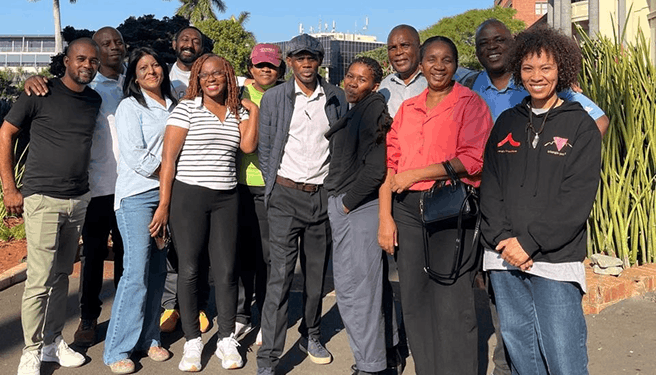
The University of KwaZulu-Natal’s (UKZN) Centre for Civil Society (CCS), within the School of Social Sciences, recently hosted its second Activist Convening for 2026, bringing together activists from across South Africa to strengthen movement-building, foster collaboration and document activist knowledge for a forthcoming publication.
The convening provided a platform for activists to reflect on their lived experiences, share lessons from community struggles and transform these experiences into written contributions that will shape a collaborative book on activism and social movements.
Participants engaged in critical discussions on action research, participatory methodologies, movement sustainability, coalition-building and resource mobilisation, while dedicating time each day to developing their written contributions.
A central theme throughout the programme was Not Yet Uhuru, a concept that acknowledges South Africa’s democratic achievements while recognising that the struggle for social, economic and political justice remains unfinished. Participants reflected on the lessons social movements have learned over the past three decades and explored how activism continues to shape a more equitable future.
The programme featured a presentation by UKZN academic Professor Oliver Mtapuri on participatory action research and community mapping, while gender equality specialist Ms Rikky Minyuku facilitated discussions on fundraising and sustaining activist work. CCS Director Associate Professor Shauna Mottiar and Postdoctoral Fellow Dr Tanja Dittfeld led a series of collaborative writing sessions that guided participants in translating their lived experiences into publishable contributions.
The convening contributes to the forthcoming publication Rethinking and Unthinking Social Movements and Activisms in South Africa: Activist Knowledges, Epistemic Justice, and Decolonial Futures, a collaborative volume that seeks to bridge academic scholarship and activist practice. The book will be published by African Minds and made freely available, ensuring that movement knowledge remains accessible to activists, researchers, policymakers and the wider public.
The book is structured in three parts: ‘Challenging the Narrative’, ‘Being an Activist’ and ‘Rethinking and Unthinking Activism’.
By creating a space where activists, scholars and community leaders can learn from one another, the Centre for Civil Society continues to advance UKZN’s commitment to engaged scholarship, community partnership and research that contributes to social transformation. Mottiar noted that the convening reflected a commitment to co-producing and recognising knowledge that often goes unacknowledged in social movement spaces.